
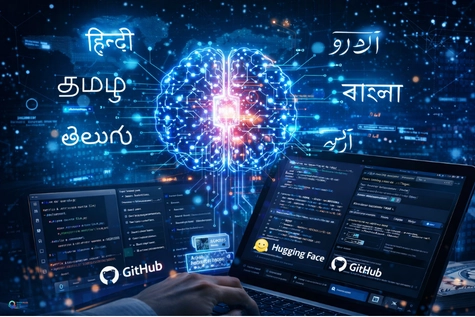
Artificial intelligence is rapidly transforming how people interact with technology, and large language models (LLMs) have been at the forefront of this revolution. Globally, models like GPT and LLaMA have showcased remarkable capabilities in understanding and generating text. However, when it comes to Indian languages, the AI landscape presents unique challenges.
India is home to hundreds of languages and dialects. While English and a few major Indian languages dominate digital content, most AI systems are heavily skewed toward English, making it difficult for millions of Indian users to fully leverage AI-powered tools. This is where open-source LLMs for Indian languages come in – models trained specifically to understand and generate text in Hindi, Bengali, Tamil, Telugu, Marathi, and other local languages.
Challenges of Indian Language AI
Building LLMs for Indian languages is not simple. Developers face several hurdles:
- Diverse Scripts and Grammar: Unlike English, Indian languages use multiple scripts (Devanagari, Tamil, Telugu, etc.), each with complex grammar rules. LLMs must understand context, sentence structure, and nuances unique to each language.
- Scarce High-Quality Data: Training AI models requires large datasets. While English datasets are abundant, high-quality corpora for Indian languages are limited. Existing datasets are often fragmented or biased toward formal language, leaving colloquial and regional dialects underrepresented.
- Multilingual Users: Many Indian users are bilingual or multilingual, often mixing English with their native language in conversations. AI models need to handle these code-mixed inputs effectively.
- Computational and Resource Constraints: Training large LLMs requires massive computational power. Open-source initiatives face the challenge of building multilingual models with limited resources compared to global tech giants.
Local Datasets and Models
To address these challenges, researchers and developers in India have started curating local datasets tailored for Indian languages. These datasets include:
- IndicCorp: A large corpus covering 12 major Indian languages for NLP research.
- Samanantar: One of the largest parallel corpora for Indian languages, useful for translation tasks.
- WikiIndic: Wikipedia content in regional languages for text training and knowledge extraction.
These datasets allow LLMs to learn linguistic patterns, grammar rules, and context specific to Indian languages. Additionally, open-source models trained on these datasets are now enabling developers to build AI applications for multilingual users.
Examples of Open-Source Indian Language Models
Several initiatives have emerged to bring AI to Indian languages:
- Indic NLP Models: These include pre-trained language models for tasks like text classification, sentiment analysis, and translation across multiple Indian languages.
- AI4Bharat: Focused on building open-source AI tools for Indian languages, including large language models, speech recognition, and text-to-speech solutions.
- Bhashini LLMs: Sponsored by the Indian government, these models are designed to support local language computing and digital inclusion.
- mBERT and XLM-R: Though not entirely Indian-focused, these multilingual transformer models support Indian languages and can be fine-tuned with local datasets for specific tasks.
These models make it easier for developers and organizations to create AI-powered applications for Indian users, ranging from chatbots and virtual assistants to translation and content moderation systems.
Benefits of Open-Source LLMs for Indian Languages
Open-source LLMs provide several key benefits:
- Democratized Access: Anyone can access, fine-tune, and deploy these models without relying on proprietary systems.
- Local Language Inclusion: Millions of users who prefer regional languages can interact with AI tools in their native tongue.
- Cost Efficiency: Open-source models reduce reliance on expensive commercial APIs, making AI more accessible to startups and smaller organizations.
- Customizability: Developers can fine-tune models for specific industries, domains, or applications, like legal, healthcare, or education.
For India, where linguistic diversity is immense, these advantages are crucial for bridging the digital divide.
The Future of Indian Language AI
The future of LLMs for Indian languages is promising:
- Better Multilingual Understanding: Models will handle code-mixed inputs more effectively, reflecting how Indians naturally communicate online.
- Voice Integration: AI systems will support speech-to-text and text-to-speech in multiple languages, enabling voice assistants and accessibility tools.
- Local Industry Adoption: Fintech, e-commerce, healthcare, and education sectors will increasingly use AI tailored for regional languages to reach a broader user base.
- Community-Driven Development: Open-source initiatives will continue to grow, with researchers, developers, and enthusiasts contributing datasets, models, and tools.
By 2026, open-source LLMs could become the backbone of India’s multilingual AI ecosystem, supporting inclusive digital experiences for millions of users.
Conclusion
Open-source LLMs for Indian languages are revolutionizing AI access in a country rich with linguistic diversity. Despite challenges like data scarcity, diverse scripts, and code-mixing, local datasets and community-driven models are empowering developers to build practical, multilingual AI applications.
From chatbots and virtual assistants to translation and analytics tools, Indian language LLMs are enabling millions of users to interact with technology in their native tongue. As more resources, models, and community contributions become available, the future of Indian language AI looks highly promising, driving inclusion, innovation, and digital growth across the country.
Fast and trusted updates from Quick Pulse News